
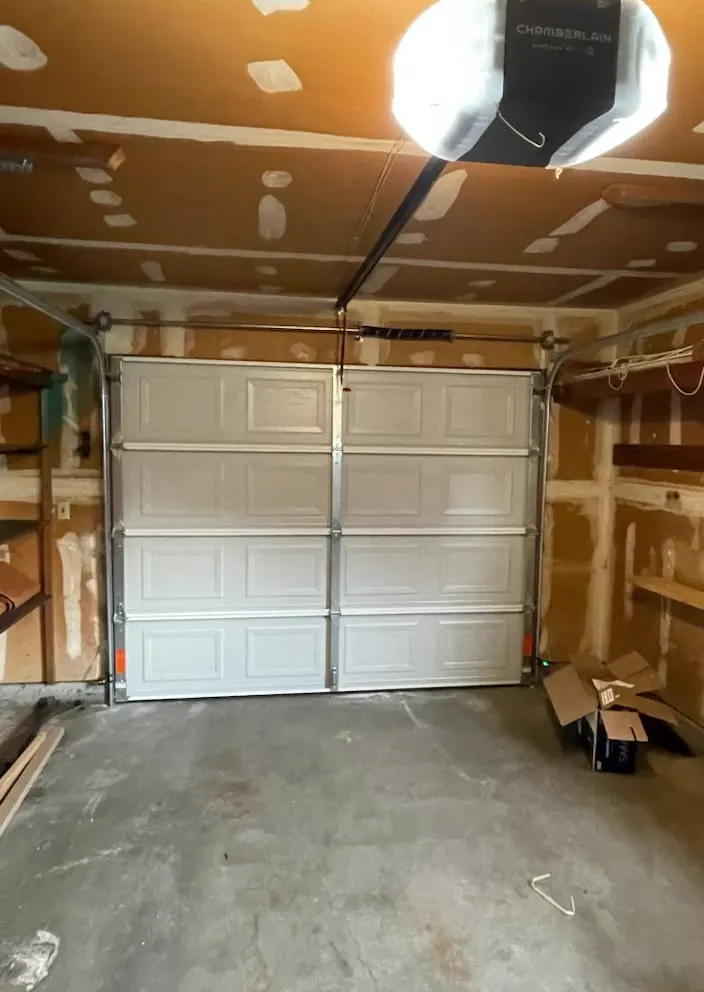
What We See After a Power Outage Call
After a coastal storm knocks out power on this side of Virginia, our dispatch phone tends to ring the next morning. The story is usually the same: someone needed to get the car out, found the red emergency release cord hanging from the opener rail, pulled it without thinking it through, and either the door came down faster than expected or it got stuck halfway. The other common call comes after the power is restored, when the opener hums and the light blinks but the door just sits there because nobody reconnected the trolley correctly. Neither problem is complicated once you know the order of operations, but doing it in the wrong order on a heavy, older door can bend a track or, worse, let a door drop on someone's hand.
Tools You'll Need
- A flashlight or headlamp (outages rarely happen in good light)
- A step stool if your release cord or manual lock is mounted higher than you can comfortably reach
- A second person, if the door is a heavier wood or insulated steel model
- Locking pliers or a C-clamp (optional, for propping the door open safely without relying on the opener arm)
You do not need any specialty tools to operate the manual release. If you find yourself needing a pry bar or anything to force the door, stop. That is a sign of a mechanical problem, not just a power problem.
Step-by-Step: Opening the Door by Hand
- Check the door's position first. If it is already down, this is the simplest and safest scenario to work from.
- Find the emergency release cord hanging from the trolley on the rail, usually with a red handle.
- Pull the cord straight down and toward the motor to disconnect the trolley from the drive carriage. You will hear a click.
- Lift the door using both hands, with your knees bent, not your back. A properly balanced door on healthy springs should rise smoothly with moderate effort and stay roughly where you leave it. If it feels heavy, jerks, or drops on its own, stop lifting — that's a spring issue, not a power issue, and continuing to force it can be dangerous.
- Prop the door open if you need it to stay up, using a clamp on the track below the bottom roller rather than trusting the opener arm, which is now disconnected.
Step-by-Step: Closing the Door by Hand
- Remove any clamp or prop you used to hold the door open.
- Lower the door with both hands, guiding it evenly so it doesn't tilt or jump off the track.
- Make sure it seats fully in the tracks at the bottom, with no gap or uneven edge.
- If your door has a manual slide lock on the inside, engage it for security, since the opener is not holding it shut while disconnected.
Re-Engaging the Opener Once Power Returns
- Close the door fully by hand first. Reconnecting the trolley while the door is partway open can throw off the opener's travel limits.
- Pull the release cord toward the door (or push the release lever, depending on your model) to reconnect the trolley to the drive carriage.
- Restore power and press the wall button. The trolley should pull into position on the first cycle, and the door should open and close normally.
- Watch and listen through one full open-close cycle. Grinding, uneven travel, or the door reversing before it reaches the floor means something shifted while the system was disconnected.
- If your opener has a battery backup, some models need the unit unplugged and replugged to reset properly after an outage — check the manual tag on the motor housing if the backup light stays on longer than expected.
What's Fine to Handle Yourself vs. What Needs a Technician
Pulling the release cord, lifting and lowering a well-balanced door, and reconnecting the trolley once power is back are all reasonable for a homeowner to do alone. Where you should stop and call for help:
- The door feels unusually heavy or uneven when you lift it — likely a spring losing tension
- The door won't stay in place, sliding back down or popping back up on its own
- The trolley won't click back into the carriage, or the opener runs but the door doesn't move
- You hear grinding, popping, or banging during the first cycle after power is restored
- The door comes off track or binds partway through a manual lift
Icy winters add another wrinkle here — cold stiffens lubricant and metal, so a door that lifted easily in October can feel noticeably heavier during a January outage. That's worth testing before the next storm, not during one.
When to Call Alexandria Garage Door Solutions
If your door felt uneven or heavy during a manual lift, or the opener didn't resync cleanly after power came back, that's our Opener Repair & Replacement or Garage Door Repair work — we check cable tension, trolley alignment, and spring balance so the system behaves correctly the next time the power drops. If it's been a while since anyone looked at the springs or hardware, our Preventive Maintenance visit is a good way to catch a weak spring before it fails during a storm-driven outage rather than after.
If your garage door gave you trouble during a recent outage anywhere from Old Town Alexandria to Kingstowne, Springfield, or Mount Vernon, call Alexandria Garage Door Solutions for a straight answer and a fix that holds.