
What waiting another season actually costs you
Here's the argument: one of you wants to order a new garage door this week because the old one is sagging, sticking, or just ugly. The other one wants to wait until "we figure out the rules." Both of you are a little right, and here's why the second position usually wins.
If you replace a garage door without checking HOA guidelines, permit requirements, and wind-load rules first, you don't just risk a fine or a stern letter. You risk paying for the door twice: once for the door you wanted, and again to remove it and install one that actually meets the architectural review standards, the structural code, or the storm rating your area requires. That's not a hypothetical — it happens whenever a homeowner orders based on looks alone and finds out afterward that the color, panel style, or window pattern doesn't match what the community association allows, or that the door isn't rated for the wind pressures it needs to withstand. A door that gets flagged after installation is a much more expensive problem than a door that gets approved before you buy it.
HOA rules: more than just paint color
If your property is part of a homeowners association, garage doors are almost always covered by the architectural guidelines, even though people assume those only apply to fences and paint. Typical HOA restrictions touch on:
- Panel style and material — raised panel vs. flush, steel vs. wood-look composite
- Color — often limited to a short approved palette matching the house
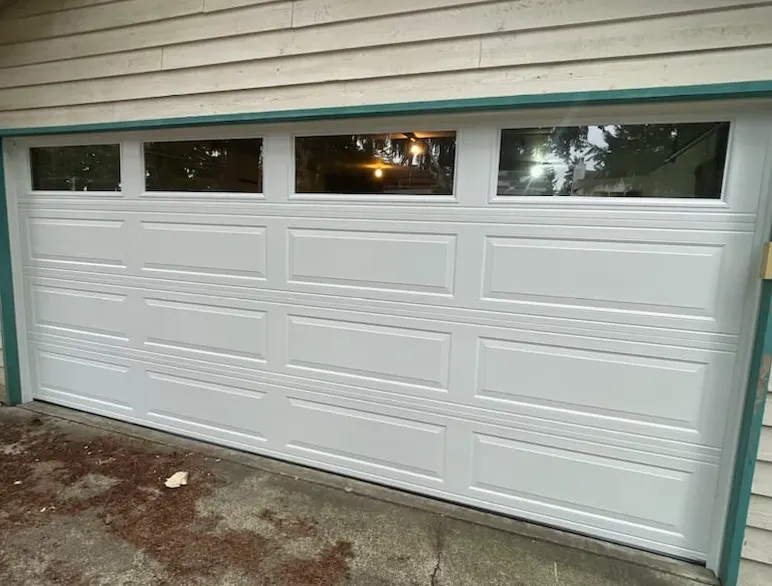
- Window inserts — shape, placement, and whether they're allowed at all
- Hardware — decorative handles, hinges, and strap hinges that mimic carriage-house doors
In neighborhoods with a mix of older and newer homes, this gets more complicated, not less. Associations covering older housing stock sometimes have stricter rules meant to preserve a consistent look, while newer developments may have more flexibility but still require a submitted request before work begins. Either way, the fix is the same: submit your door selection — including a spec sheet, not just a photo — to the architectural committee and get written approval before you place an order. Verbal "that should be fine" from a neighbor on the board does not count as approval.
Permits: when a garage door needs one and when it doesn't
Not every garage door replacement requires a permit. A straightforward swap — same size opening, same general structure, no changes to the header, framing, or electrical for the opener — is often treated as routine maintenance in many jurisdictions. But a permit is typically required when the project involves:
- Widening or resizing the door opening
- Structural changes to the header or supporting framing
- New electrical circuits for a different type of opener
- Converting an opening that wasn't previously a garage door (or vice versa)
The only way to know which category your project falls into is to call your local permitting office before the door is ordered, not after it's sitting in your driveway. This is a five-minute phone call that can save weeks of rework. If a permit is required and skipped, it can surface later during a home sale, an insurance claim, or a future renovation — at which point it's your problem to resolve, often at a worse time than now.
Wind-load codes: not optional in a storm-prone region
This part isn't about bureaucracy — it's about physics. Garage doors are one of the largest openings in a home's exterior, and when wind pressure pushes against a door that isn't rated to handle it, the door can buckle, bow, or blow in entirely, which then lets wind pressure build up inside the garage and stress the roof structure from underneath. Given the occasional coastal storms and heavy rain that roll through this part of Virginia, a wind-load rating isn't a premium upgrade you can skip to save money — it's a baseline requirement tied to local building code for your specific wind zone.
When you're comparing doors, ask the manufacturer or installer for the door's wind-load rating in pounds per square foot, and confirm it matches what your jurisdiction requires for your zone. A door that looks identical to a wind-rated model but lacks the reinforced struts, heavier-gauge steel, or reinforced track hardware will not perform the same way when a storm actually tests it.
How to settle the argument, practically
- Pull your HOA's architectural guidelines document (not just the bylaws) and check garage door specifics
- Call your local permitting office and ask directly whether your planned replacement needs a permit
- Ask your installer for the wind-load rating of any door you're considering, in writing
Do all three before you place an order, and the argument is over — you both end up with a door that's approved, legal, and durable.
When to call Alexandria Garage Door Solutions
If you're ready to move forward but want someone who already knows what questions to ask, that's where our Garage Door Installation service comes in. We'll walk through your HOA's style requirements with you, flag anything that's likely to need a permit before we start, and make sure whatever door we install carries a wind-load rating appropriate for this area's storm exposure. For businesses weighing the same questions on a larger scale, our Commercial Garage Door Service team handles the same code and permit considerations for commercial door replacements.
Call Alexandria Garage Door Solutions before you order anything, and we'll help you get it right the first time — serving Alexandria, Springfield, Kingstowne, Annandale, Fairfax, Burke, Lorton, and Mount Vernon.